How to Validate a Startup Idea Before You Build Anything
Learn how to validate a startup idea before building by testing demand, researching alternatives, and separating real evidence from hopeful assumptions.
Startup idea validation is not a ceremony that declares an idea safe. It is a short process for finding the assumption most likely to make the business fail, collecting evidence about it, and deciding whether to build, revise, or pass. Before you write code, you can test whether a specific customer has the problem, how they handle it now, what would make them switch, and whether they will make a meaningful commitment. You cannot prove retention or scalable growth before a product exists, but you can avoid building on assumptions that were easy to challenge.
That distinction matters most to technical founders. When implementation is fast, building feels like progress and research feels like delay. But a working product answers “can I make this?” long before it answers “will the right customer care enough to change behavior?” Validation should compete with the urge to code by producing a decision quickly, not by becoming weeks of worksheets.
What startup idea validation actually means
At the beginning, your startup is a stack of hypotheses. You believe a particular group has a particular problem, experiences it often enough to act, can be reached, will prefer your approach to current alternatives, and can support a business. Those statements may be reasonable. They are not facts because they appeared in a pitch deck.
Steve Blank's Customer Development Manifesto draws the basic line: early business models are hypotheses, and the facts live outside the building. Validation means replacing the most consequential hypotheses with external evidence. It does not mean asking enough people to like the idea.
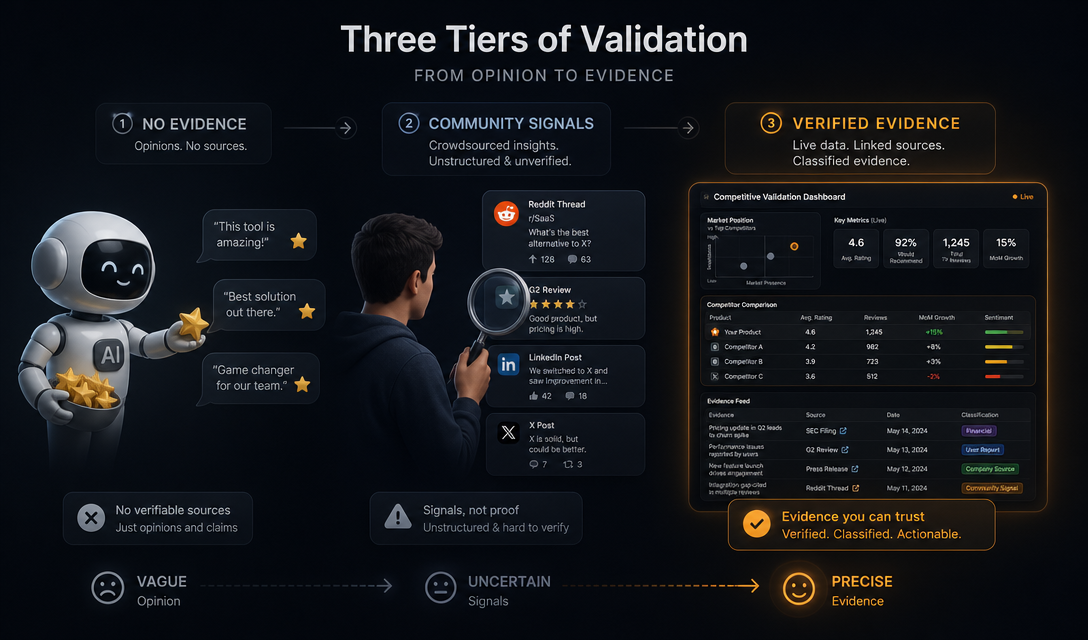
A useful evidence ledger has three labels:
- Fact: something directly observed or supported by a current source.
- Inference: a conclusion drawn from facts, with the reasoning visible.
- Assumption: something that needs to be true but has not been demonstrated.
Suppose you want to build an AI inbox for independent property managers. “Small property managers answer repetitive tenant questions” may be supported by interviews and workflow observation. “They will trust an autonomous agent to reply” is a different claim. “They will pay $99 per month” is another. A search result about the property-management software market does not validate either one.
The output of validation is therefore not a green check. It is a smaller set of unknowns, a clearer risk, and a next action that can change the decision.
Start with the assumption that can kill the idea
Do not begin with the easiest question to research. Begin with the belief that is both essential and weakly supported. Strategyzer's guidance on critical hypotheses makes the same point: shape the idea into assumptions before treating “build” as the first step.
Write one sentence for each part of the business:
- Customer: “Freelance video editors with at least five active clients have this problem.”
- Problem: “Collecting and resolving client feedback causes repeated rework every week.”
- Alternative: “They currently combine email, timestamped comments, and chat.”
- Value: “A single review workflow would reduce a costly handoff.”
- Switching: “The pain is strong enough to move an active project.”
- Reach: “We can find these editors through a specific community or partner.”
- Economics: “The person who feels the pain can authorize the price.”
- Delivery: “We can produce the promised outcome with acceptable reliability.”
Then ask two questions about every sentence: What happens if this is false? What evidence do we have beyond our own experience?
The assumption with the worst combination of consequence and uncertainty goes first. If the buyer cannot authorize a purchase, testing button colors is irrelevant. If the workflow occurs once a year, improving it may not be urgent. If a regulated integration is infeasible, a waitlist will not remove that constraint.
Make the assumption falsifiable. “Teams struggle with feedback” is too soft. “At least four of the next eight agency editors will show a feedback-related delay from a project completed in the last month” can fail. The numbers are not universal truth; they are a threshold you choose before seeing results so you cannot redefine success afterward.
If you want a wider diagnostic before selecting the first risk, use the evidence-first startup scorecard. Its purpose is to expose weak dimensions, not to manufacture a probability of success.
Look for behavior, not compliments
“Would you use this?” invites imagination and politeness. “Tell me about the last time this happened” asks for a recoverable event. The difference is not that customers lie. People are simply poor witnesses to a future with no cost, deadline, or competing priority.
In problem interviews, stay on their current life:
- When did the problem last happen?
- What triggered it?
- What did you do, step by step?
- Which tools or people were involved?
- What did the workaround cost in time, money, delay, or risk?
- Who cared about the outcome?
- What have you already tried to change?
The official teaching material for The Mom Test emphasizes recognizing biased questions and using commitment or advancement to judge early interest. Commitment can be time, access, reputation, or money: a follow-up with the actual buyer, an introduction to a colleague, permission to observe the workflow, sample data for a manual trial, a scheduled pilot, or a deposit where appropriate.
None of these alone proves a company. They are stronger than praise because the other person gives up something they value. Record the action separately from the words. “Loved the concept” and “introduced us to the operations director” are not the same signal.
Interview the segment named in your hypothesis, including people who stopped using an alternative or refused to buy. Five rich conversations with the right workflow can reveal more than a large survey sent to whoever was easy to reach. Do not turn that observation into another magic number. Stop when new conversations repeat the same pattern and the next uncertainty requires behavior, not more stories.
Research alternatives before designing features
Competition is not limited to startups with the same tagline. The current alternative might be a spreadsheet, an assistant, a consulting firm, a feature inside a larger suite, or accepting the pain. “No competitors” often means the search was too literal.
Map alternatives around the job:
- Search the problem in the customer's language, not your category name.
- Read product pages, documentation, pricing, changelogs, and public reviews.
- Look for the workaround described in interviews.
- Note who buys, the trigger, the promise, the price model, and the switching cost.
- Separate a verified fact from your interpretation.
For example, “Vendor A charges $49 per seat on its current pricing page” is a fact with a source and date. “Small teams will find that expensive” is an inference until target customers show it. “Our simpler UI will make them switch” is an assumption.
Existing alternatives can be encouraging: spending and repeated workarounds show that a problem exists. They can also make the idea harder. A mature incumbent may own the channel, data, or trust required to deliver the outcome. Your task is not to prove the market is empty. It is to identify a narrow reason the target customer would change.
Research also prevents feature-first positioning. If every competitor sells an “AI workspace,” another AI workspace is not differentiation. A credible wedge might be a neglected workflow, a distribution advantage, faster time to value, a different risk model, or unique access to the customer. Each is still a hypothesis until behavior supports it.
Move up the evidence ladder
Evidence becomes more useful as it approaches the behavior your business needs. Strategyzer's Testing Business Ideas organizes experiments by cost, time, and evidence strength. That is more useful than treating every survey, waitlist, interview, and sale as equivalent.
A practical sequence might look like this:
- Public evidence and alternative research establish context.
- Past-behavior interviews establish a recurring problem and current response.
- A landing page tests whether a specific promise causes a specific audience to act.
- A concierge test manually delivers the outcome and exposes the real workflow.
- A design partnership, preorder, or budgeted pilot tests commitment.
- Payment and repeated use test whether value survives contact with reality.
You do not have to perform every step. Choose the cheapest test capable of changing your decision. A technical proof of concept may come early when feasibility is the largest risk. A paid manual service may precede a UI when workflow and willingness to pay are uncertain. YC's essential startup advice explicitly supports unscalable manual work with early customers as a route to learning what should be built.
Define the experiment before running it:
- assumption under test
- target participant and recruitment source
- action they must take
- threshold that supports continuing
- result that would make you revise or stop
- evidence the experiment cannot produce
Our seven business-idea experiments compare these signals in more detail. The hierarchy is a decision aid, not a scientific scale. A targeted, costly action can outweigh a thousand low-intent clicks.
Decide: Build, Revise, or Pass
Research is only valuable if it changes resource allocation. End the cycle with one of three decisions.
Build means the largest known risk has enough evidence to justify the next investment. It does not mean the startup is validated forever. State exactly what you will build, which assumption it tests, how long it should take, and what result would earn more investment.
Revise means the problem appears real but part of the model did not survive: the segment, trigger, buyer, promise, channel, or delivery approach needs to change. Preserve the evidence, rewrite the affected hypothesis, and run the next smallest test. Do not call every setback a pivot; explain what changed and why.
Pass means a critical assumption failed, the available opportunity does not justify the cost, or the founder lacks a credible path to the customer. Passing is not a verdict that nobody could ever build the idea. It is a decision that this version, with current evidence and constraints, does not deserve more of your time.
Set a decision date before research expands. If every negative result creates three new interviews and every positive result is treated as insufficient, validation has become avoidance. The strongest counterargument to validation-first thinking is legitimate: sometimes the next useful evidence only comes from shipping. The answer is not endless pre-build work. It is building the smallest thing that resolves the next uncertainty.
What to test next
Start with a one-page evidence brief:
- Describe one customer and one recurring situation.
- List the three current alternatives, including doing nothing.
- Write the five assumptions that must be true.
- Mark each as fact, inference, or assumption.
- Select the most consequential weak assumption.
- Design one test that can fail within a week.
- Predeclare Build, Revise, and Pass thresholds.
AI can help search, compare sources, challenge logic, and keep this ledger organized. It cannot create the customer action the test requires. The limits of AI idea validation are simple: analysis can improve the question, while evidence must still trace to the world outside the model.
The goal is not certainty before code. It is to make the next unit of code earn its place.