The 2026 Startup Validation Tools Landscape: Why Most AI Validators Are Just Guessing With a Nicer UI
Most AI validation tools give you a score but can't show where it came from. The 2026 landscape has split into three tiers — here's how to spot the difference.
You run your startup idea through an AI validation tool. It comes back with a score: 8.2 out of 10. "Strong market potential," it says. "Favorable competitive landscape."
You feel good. You start building.
Six months later, you launch to crickets. Nobody pulls out a credit card. The competitors the tool never mentioned are already dominating the space with better pricing and deeper integrations.
What happened?
The tool didn't validate your idea. It gave you an opinion with formatting.
This is the state of AI-powered startup validation in 2026 — and if you're betting months of your life on one of these tools, you need to understand what's actually happening under the hood.
The Validation Tools You're Using Are Lying to You
Here's the uncomfortable truth about most AI validation tools: they don't know anything about your specific market. They're generating confident-sounding analysis from training data that was cut off months or years ago. They can't name your real competitors. They can't pull live pricing. They can't tell you whether the "strong demand" they're seeing is from three Reddit threads or three thousand paying customers.
When a founder on r/SaaSValidations tested five different AI validation tools with the same idea, they found the same gap across all of them: none forced you to define the buyer before generating the report. The tools were happy to analyze "the market" without knowing who the market actually was.
"If a validation report can't show you where a number came from," they wrote, "it's an opinion with formatting."
That line should be pinned to every founder's monitor.
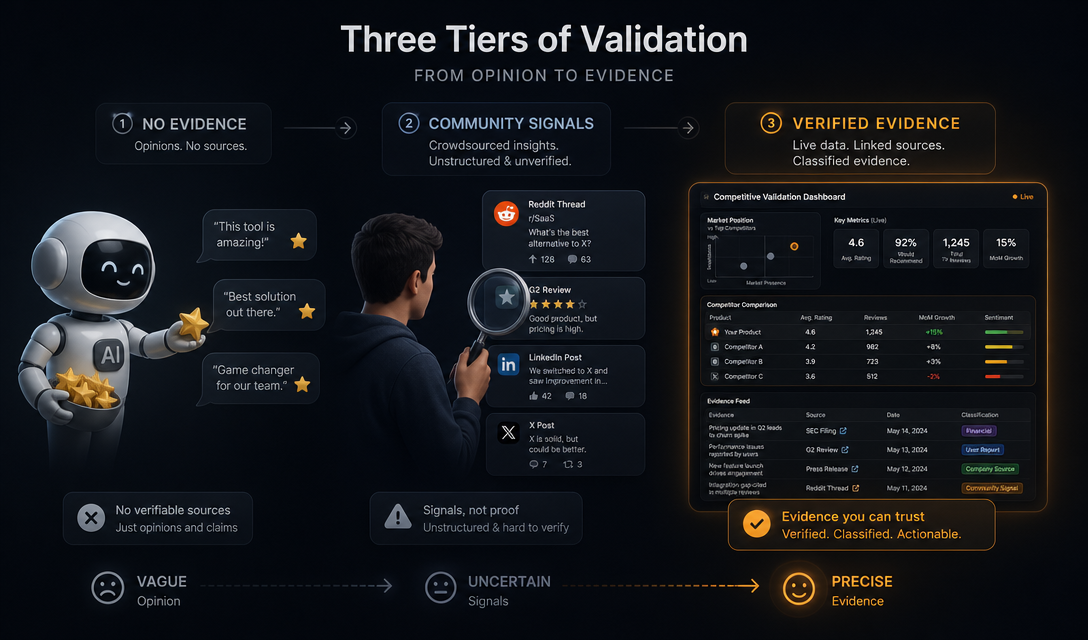
Three Tiers of Validation Tools in 2026
The 2026 validation tools landscape has split into three distinct tiers — and which one you're using determines whether you're actually validating or just collecting encouragement.
Tier 1: AI-Opinion Tools
These are the most common — and the most dangerous. They take your idea description, run it through an LLM, and output a structured report with scores, SWOT analyses, and market sizing. The output looks professional. The numbers feel precise.
But none of it is sourced. The "market size" is an LLM's best guess based on training data. The "competitor analysis" names companies the model happened to encounter during training — not the ones actually competing for your target customers right now.
These tools are essentially brainstorming partners dressed up as analysts. They're useful for exploring angles on an idea. They're useless for making a build-or-pass decision.
Tier 2: Demand/Pain-Evidence Tools
The second tier pulls real community signals — Reddit threads, review sites, social media conversations — to measure whether people are actually complaining about the problem you're solving.
This is a meaningful step up. A "loud pain signal" is real evidence that a problem exists.
But here's the catch: a loud pain signal in a saturated market still results in a bad business. These tools can tell you people are frustrated, but they can't tell you whether the market already has ten well-funded solutions addressing that exact frustration. Pain discovery alone is necessary but insufficient.
Tier 3: Full Viability Tools
The third tier combines live competitive research, market signal analysis, and — critically — source-linking for every claim. These tools don't just tell you your idea has potential. They name the competitors. They show you their pricing. They distinguish between verified evidence, reasonable inferences, and unverified assumptions.
This is the tier where validation actually happens. Everything below it is research theater.
The Evidence Problem: Why "8.2/10" Means Nothing
Numbers without sources are just decoration.
When a validation tool gives you a score — whether it's "market potential: 8.2/10" or "competitive risk: low" — the only thing that matters is whether you can trace that number back to something real.
Ask yourself: did the tool pull live pricing data from competitor websites? Did it analyze actual customer reviews for sentiment? Did it measure search volume for the problem you're solving? Or did it make a reasonable-sounding guess based on the general shape of your idea?
Most tools can't answer those questions because they never asked them in the first place. They generated a score the same way ChatGPT generates a recipe — by predicting what a validation report should look like, not by investigating what's actually true.
The market is starting to notice. The shift toward live data retrieval and mandatory source-linking is the most important trend in validation tools this year. Founders who've been burned by building in the dark are demanding receipts.
What a Real Validation Tool Should Do
If you're evaluating a validation tool — or building one — here's what separates signal from noise:
1. Name the competitors. Specifically. Not "companies in the CRM space." Actual names, with actual pricing, pulled from live data. If the tool can't tell you who you're competing against, it hasn't done the research.
2. Show the sources. Every claim about market size, demand, competitive positioning, or risk should link back to where the evidence came from. If there's no source, it's not evidence — it's speculation.
3. Distinguish evidence from inference. Some conclusions are backed by hard data. Others are reasonable extrapolations. Others are assumptions dressed up as analysis. A useful tool labels which is which so you know what you're betting on.
4. Define the buyer first. Before any analysis happens, the tool should force you to specify who you're selling to. "Everyone" is not a target market — it's a fantasy. ICP first, analysis second.
5. Give you a real verdict. Not a score. Not a confidence percentage. A clear recommendation — Build, Revise, or Pass — backed by the specific evidence that supports it. Validation that can't say "pass" isn't validation. It's flattery.
The Questions to Ask Before You Trust Any Report
Before you spend months building based on a validation report, ask these five questions:
Can I trace every number back to its source? If not, treat the analysis as directional at best.
Does this report name my actual competitors — with pricing? Generic competitive analysis is worse than useless. It creates false confidence.
Did the tool know who my buyer was before it started? If the report was generated without a defined ICP, it wasn't analyzing your market. It was analyzing a statistical average of all markets.
Would this tool ever tell me to pass on an idea? If every idea gets a positive score, the tool isn't validating — it's optimizing for user retention.
What's the single riskiest assumption in this analysis? A good validation tool should tell you what it's least confident about, not hide uncertainty behind a polished score.
The validation tools landscape is maturing fast. The AI-opinion tools that dominated 2024 and 2025 are being exposed for what they are: confident guessers. The tools that will matter in 2026 and beyond are the ones that treat evidence as a requirement, not a feature.
If your validation tool can't name the competitor and show you the source, it's not validating your idea.
It's guessing with a nicer UI.
And guessing isn't a strategy — it's how you end up six months into a build with zero customers and a hard question about what you missed.