How to Test a Business Idea: 7 Experiments Ranked by Signal Strength
Compare seven ways to test a business idea, from compliments and surveys to preorders and payment, ranked by the strength of evidence they produce.
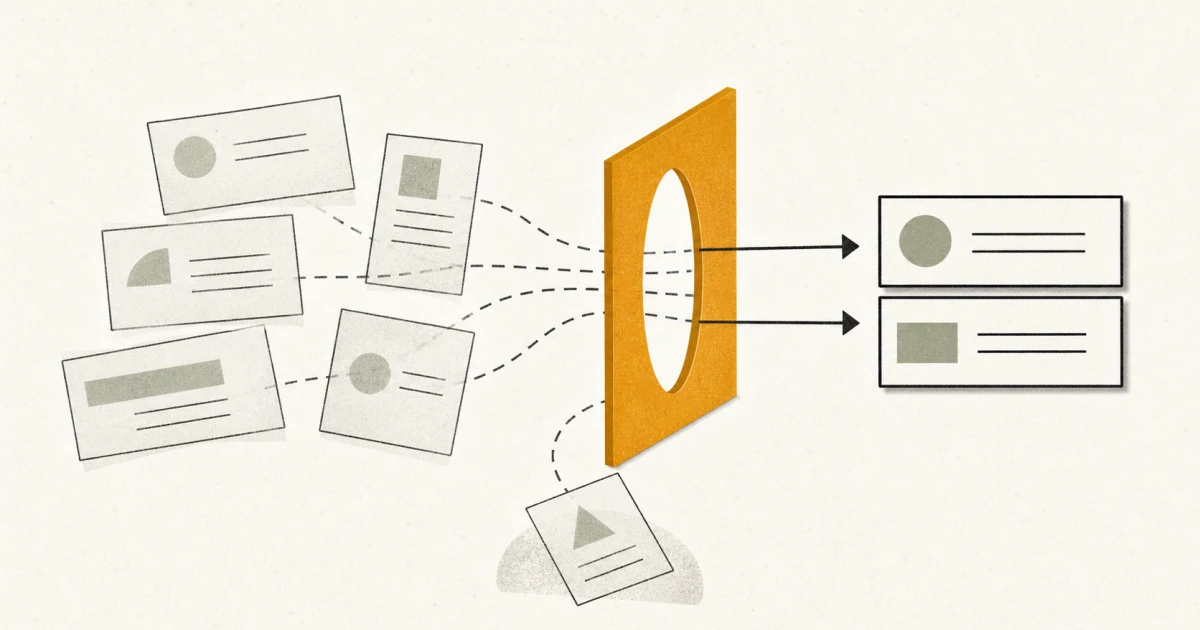
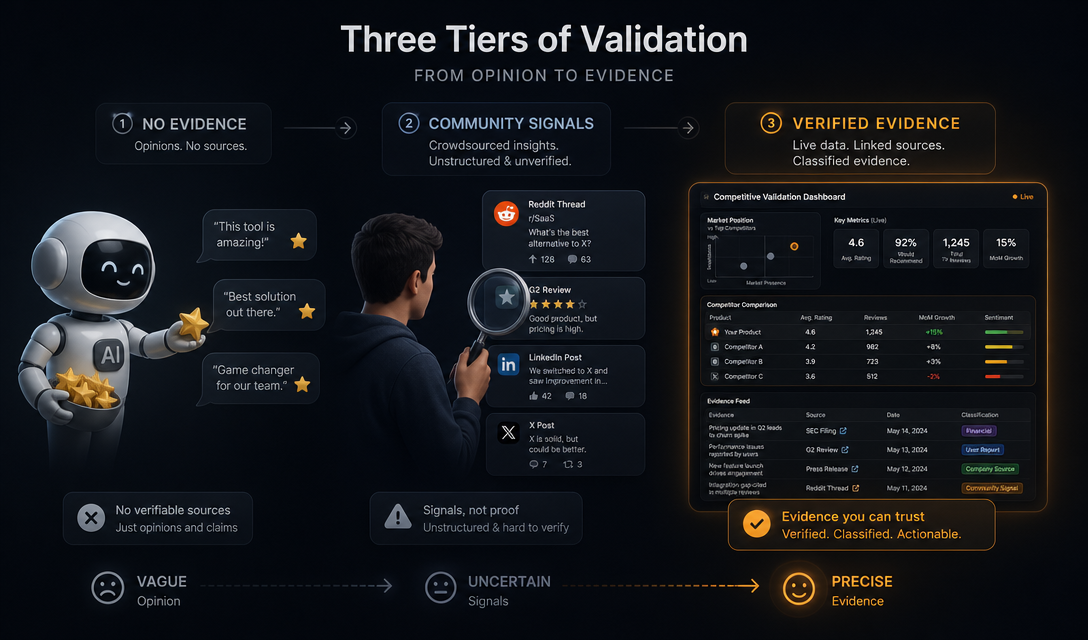
The best way to test a business idea is to choose the cheapest experiment that can disprove its riskiest assumption. Start with observed problems, then move toward actions that resemble the behavior your business needs: a qualified reply, a booked call, a preorder, payment, or repeated use. Do not count every signal equally. Compliments tell you far less than a customer sacrificing time, reputation, access, or money.
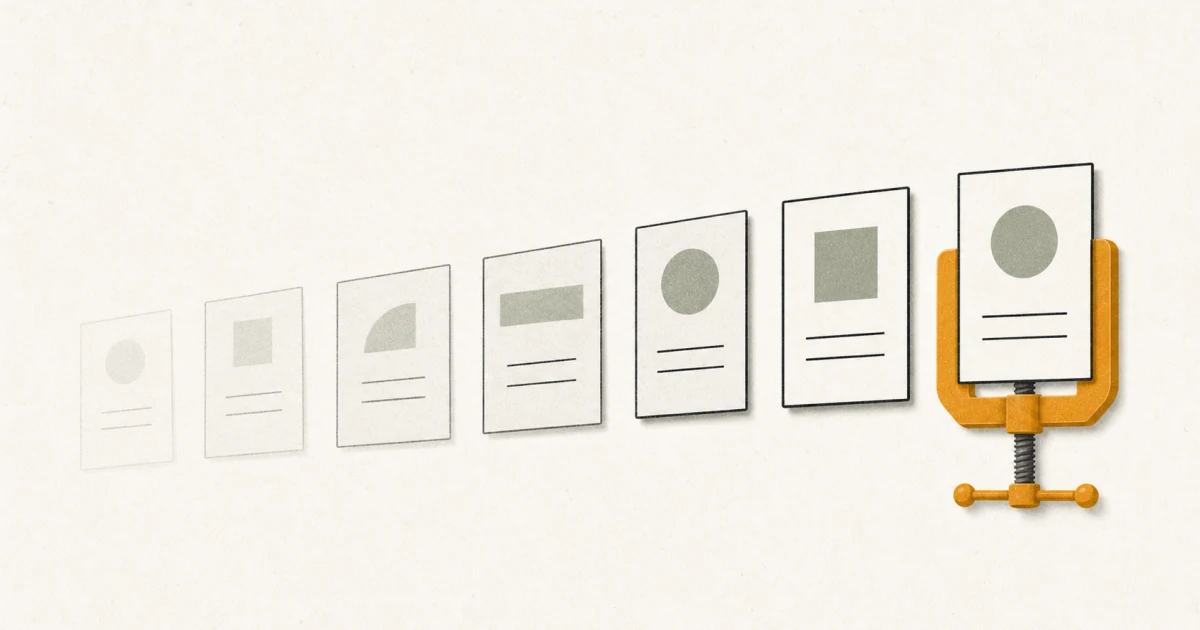
The seven experiments below are ranked by their usual proximity to real customer behavior. This is a practical ladder, not a universal scientific scale. A targeted interview can be stronger than an untargeted waitlist, and a budgeted free pilot can be stronger than a casual low-price preorder. Judge the actual sacrifice, decision authority, and match to the target transaction.
Not all validation signals deserve equal weight
Every experiment should begin with five written fields:
- the assumption under test
- the exact participant segment
- the action you will observe
- the threshold chosen before results arrive
- what you will do if the result is above or below that threshold
Without these fields, founders tend to collect encouraging facts and explain away discouraging ones. Fifty waitlist signups can look impressive until you remember they came from other founders trading support. Three buyer introductions can look small until you notice each person risked a professional relationship to make one.
Strategyzer's Testing Business Ideas compares experiments by setup cost, time, and evidence strength. Its guidance on testing value propositions and business models also distinguishes verbal evidence from actions that demand more effort. The ladder below turns that principle into seven usable tests.
1. Compliments
Show or describe the idea and listen to the reaction. This is the easiest test and the easiest to misread.
What it proves: A positive reaction can show that the pitch is understandable, socially acceptable, or interesting enough to continue the conversation. Confusion is useful too: if the intended customer cannot repeat the value in plain language, the message needs work.
What it does not prove: Praise does not establish a recurring problem, switching intent, budget, usage, or demand. “That's cool” costs nothing. Friends and peers may be evaluating your creativity rather than their own willingness to change.
Stop or continue when: Stop counting compliments as validation immediately. Continue the conversation only by moving to a fact question or a commitment: “When did this last happen?” “Can you show me how you handle it?” “Who else owns this problem?” A compliment that leads nowhere is feedback on the conversation, not the business.
Use this level for message comprehension, not go/no-go decisions.
2. Survey intent
A survey asks a larger group about problems, preferences, frequency, or hypothetical purchase. It can be fast, but question design and recruitment determine whether the numbers mean anything.
What it proves: A well-targeted survey can compare stated patterns within the respondents. It can reveal which pains people recognize, which alternatives they report, or which segment deserves deeper research. A forced ranking can be more informative than “Would you use this?”
What it does not prove: Stated intent is not observed behavior. A respondent does not face the real price, onboarding work, manager approval, or competing priority. A large sample from the wrong audience does not repair the test. Percentages also inherit every bias in the question and recruitment source.
Stop or continue when: Continue only when the result identifies a specific uncertainty for a behavioral test. Stop if the survey exists merely to produce a reassuring market-size percentage. Follow surprising answers with interviews about recent events, not more hypothetical checkboxes.
A survey is a map for where to look. It is rarely the destination.
3. Problem interviews
Talk to people in the target segment about a recent instance of the problem. Do not begin with a demo. Reconstruct the trigger, workflow, workaround, consequence, and people involved.
What it proves: Interviews can establish that the situation occurs, describe how it unfolds, expose existing alternatives, and reveal the language customers use. Specific past behavior is especially useful: tools opened, steps taken, money spent, delays caused, and previous attempts to improve.
The official resources for The Mom Test emphasize detecting biased questions and looking for commitment or advancement rather than polite approval.
What it does not prove: Interviews do not establish future purchase, product usability, retention, or market prevalence. Interviewees may remember poorly, and the founder can lead them. Ten similar stories from a convenient peer group may say little about the intended buyer.
Stop or continue when: Continue until new conversations stop changing the risk map, not until you hit a ceremonial number. Stop interviewing when the next important uncertainty requires action: seeing a prototype, sharing data, introducing the buyer, or trying a manual service. If stories remain inconsistent, narrow the segment or trigger before recruiting more people.
The goal is a reliable problem model, not a folder of quotes.
4. Landing-page or waitlist behavior
Put a specific promise in front of a defined audience and ask for a meaningful next step. The page can request an email, application, data sample, deposit, or booked conversation. The action should match the stage and risk.
What it proves: A landing page can test whether a message and offer cause observable action among the people you reach. Comparing qualified traffic sources and messages can help identify a promising segment or trigger.
What it does not prove: Signups do not establish product value, retention, willingness to pay, or total market demand. Results are inseparable from traffic quality. A viral post among supportive builders may create a large list with no buyers. A weak page can also hide real demand by explaining the problem badly.
Stop or continue when: Before launch, choose a qualified-action threshold and define “qualified.” Continue when the intended segment converts and agrees to the next step. Revise the audience, promise, or channel when visitors are wrong or confused. Stop investing in list size when subscribers repeatedly refuse interviews, trials, or commitments.
Record the denominator, source, and action. “500 signups” without those fields is decoration.
5. Booked calls and design-partner conversations
Ask a qualified customer to spend time exploring the workflow, provide data, introduce stakeholders, or co-design a trial. This level moves beyond anonymous interest because someone accepts coordination cost.
What it proves: A booked and attended call shows willingness to spend time. A design partner who shares real artifacts, involves colleagues, schedules a follow-up, or tests a manual workflow provides stronger evidence about the problem and buying process. You can discover security, integration, trust, and approval constraints before building around them.
What it does not prove: Time is not budget. Innovation teams may take meetings without the authority or urgency to buy. A design partner may request custom features that do not generalize. Free pilots can attract participants who would never adopt at the required price.
Stop or continue when: Continue when the right person advances the process with a concrete action and date. Treat “keep me posted” as no advancement. Stop or reshape the offer when calls repeatedly stay educational, never reach the decision-maker, or demand incompatible custom solutions. Ask what the partner is risking and who can authorize the next step.
Design partnerships are valuable when they reveal a repeatable product, not when they disguise consulting.
6. Letters of intent and preorders
Ask for a commercial commitment before full delivery. Depending on the business, this might be a refundable deposit, preorder, signed letter of intent, procurement step, or pilot with allocated budget.
What it proves: The signal becomes stronger when the authorized buyer sacrifices money, reputation, legal attention, or internal political capital. It tests whether the problem can survive a real commercial conversation and whether the proposed terms fit the buying process.
What it does not prove: A non-binding letter can be cheap. A refundable preorder may overstate final purchase. Neither proves that you can deliver, retain users, or acquire customers economically. Consumer preorders may be inappropriate in regulated or trust-sensitive categories; enterprise procurement can make a signed document costly even without cash.
Stop or continue when: Continue when the commitment comes from the target buyer, has meaningful terms, and advances toward delivery. Reassess when supporters sign anything to be helpful yet resist a start date, data access, security review, or budget. Stop using the label “LOI” as evidence unless you can explain the actual sacrifice it contains.
The paperwork is not the signal. The cost of saying yes is.
7. Payment or repeated usage
Deliver enough of the promised outcome for customers to pay or use it again. This can begin as a manual concierge service. Software is not required to test whether the result matters.
What it proves: Payment demonstrates a real exchange of value under the observed terms. Repeated use or renewal shows that value may persist after novelty and onboarding. Together, behavior from the target segment is the closest evidence to the business you intend to operate.
YC's essential startup advice recommends doing unscalable manual work for early customers because founders are still learning what should be built.
What it does not prove: One customer does not establish market size, repeatable distribution, healthy margins, or retention across a segment. Founder-led service may create value the eventual product cannot reproduce. Discounts, personal relationships, and custom work can distort the result.
Stop or continue when: Continue investment when target customers pay or return for the same core outcome and delivery begins to repeat. Investigate churn before acquiring more users. Stop scaling when every sale requires a different product, support cost exceeds the price, or customers pay once but do not reach value. The next test may be retention or channel economics, not another feature.
Payment is powerful evidence, not a certificate for the entire company.
Choose the cheapest test that can change your decision
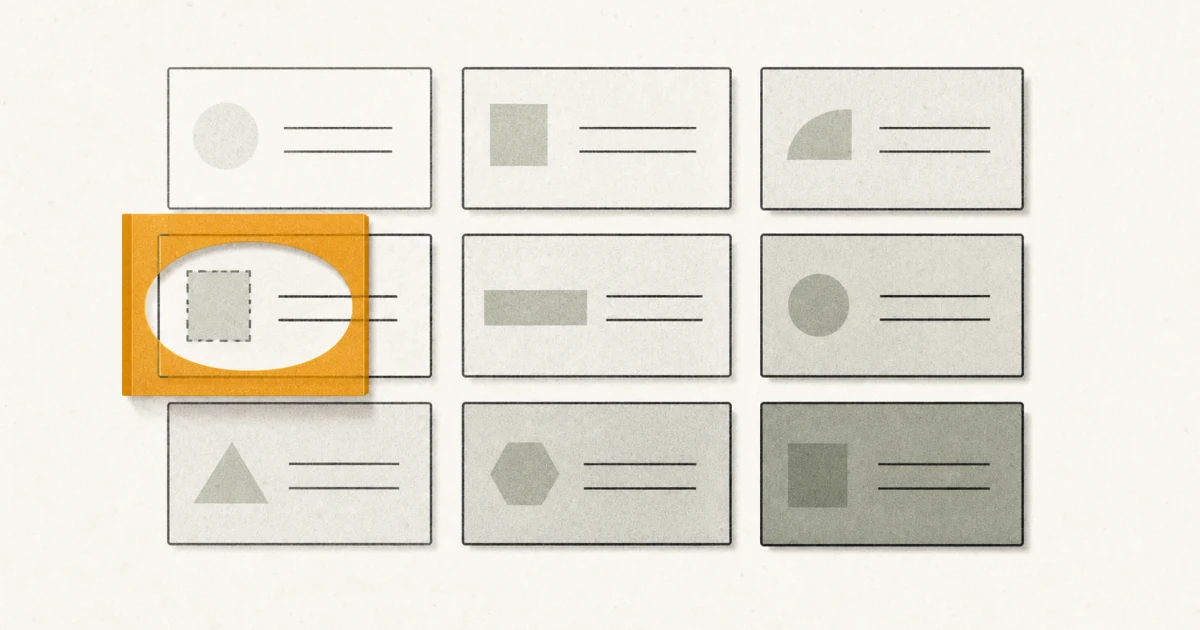
Do not climb the ladder mechanically. Match the experiment to the riskiest assumption.
If you do not know whether the problem occurs, run interviews before a preorder. If the problem is obvious but the technical outcome is uncertain, run a proof of concept. If buyers describe severe pain but never act, request a commercial commitment. If customers pay but disappear, test onboarding and repeated value. If retention looks good but growth is expensive, test a specific acquisition channel.
A seven-day test plan can fit on one page:
- Assumption: Operations managers will share last month's exception log because reconciliation is painful.
- Segment: Managers at independent logistics firms with 20–100 drivers.
- Test: Ten targeted conversations followed by a request for anonymized sample data and a booked manual review.
- Continue: At least three qualified managers provide data and attend the review.
- Revise: The pain exists, but another role owns the data or decision.
- Stop: The workflow is rare, low consequence, or nobody advances.
- Cannot prove: Price, product retention, and scalable acquisition.
The threshold is a founder decision, not a universal benchmark. Its value is that it prevents you from rewriting success after the result.
If you need to identify which assumption deserves the test, start with the evidence-first scorecard. If you need the complete sequence from assumptions to Build, Revise, or Pass, read how to validate a startup idea before building.
Testing does not remove uncertainty. It buys better uncertainty at a lower cost. The right experiment is the smallest real-world event that can make you change your mind.