The Customer Evidence Pyramid: Why Most Founders Are Validating With the Equivalent of 'Trust Me Bro'
Most founders validate ideas with opinions and anecdotes. The Customer Evidence Pyramid explains why that fails — and what real validation requires.
In medicine, nobody launches a drug because a doctor "has a good feeling about it." Before a treatment reaches patients, it climbs an evidence hierarchy: case reports, observational studies, randomized controlled trials, systematic reviews. Each tier filters out the noise from the tier below. Skip a tier, and people die.
Startups have no such requirement. Anyone with a laptop and conviction can spend six months building a product based on a single conversation, a gut feeling, or — worse — a friend saying "that sounds cool." Then they launch and discover what the evidence hierarchy would have told them at week one: nobody wants this.
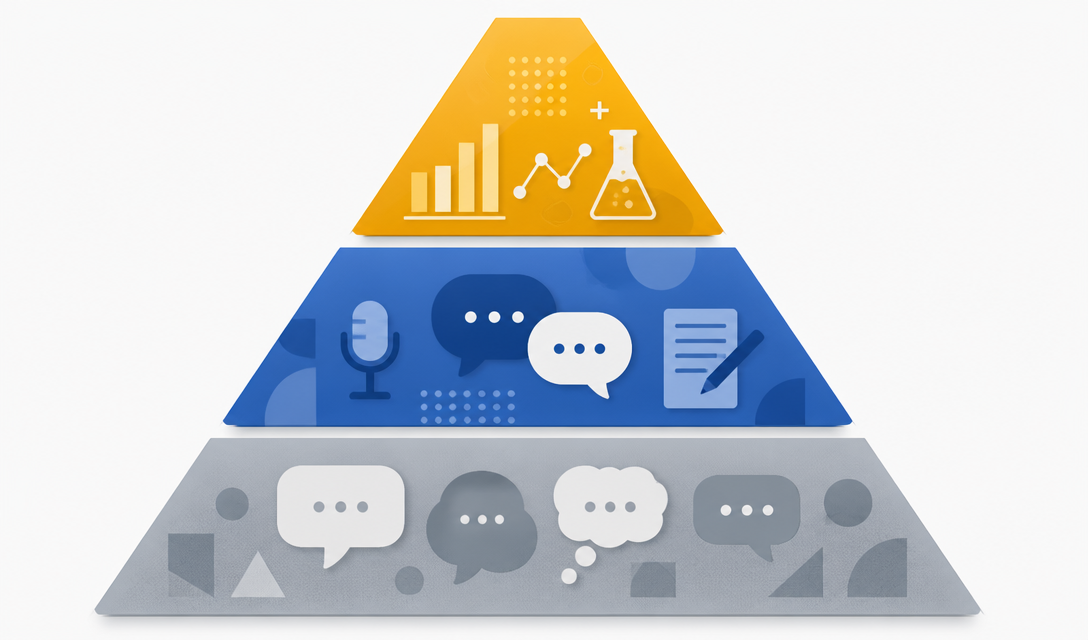
This isn't a metaphor. First Principles Ventures, a firm that studies product failure patterns, has formalized exactly this parallel. They call it the Customer Evidence Pyramid — a hierarchy that ranks the reliability of every signal founders use to make build decisions. And the uncomfortable truth is that most founders never leave the bottom tier.
The Three Tiers of Evidence (And Where You Actually Are)
Bottom Tier: Opinions, Assumptions, and Anecdotes
This is the "trust me bro" level. It includes:
- Past experiences ("I worked in this industry, so I know what they need")
- Assumptions ("Nobody else is doing this, so the market is open")
- Anecdotes ("Three people told me they'd pay for this")
- Macro analysis reports (too broad to be actionable for a specific product)
The bottom tier feels like validation because it involves data. You read a Gartner report. You looked at market size. You asked five friends. But every item at this tier shares the same fatal flaw: none of it measures whether a specific customer will take a specific action — open a wallet, sign a contract, switch from an existing tool — for your specific product.
This is where the Ex-Google founder on r/SaaS spent months 3 through 15 of his startup journey. He saw a competitor in the AI automation space and assumed that proved demand. "I was copying a working idea, I felt that it will DEFINITELY work out," he wrote. The competitor existed — that was his evidence. What he didn't ask: why was there only one? Were they making money? Were their customers happy?
When he finally started selling, he discovered the real market: "Companies had no idea what to do with AI." The competitor wasn't proof of demand. It was the exception that proved how hard the space actually was.
Middle Tier: Qualitative Research
This is where evidence starts to get real. It includes:
- Customer discovery interviews (not pitching — listening)
- In-depth conversations with people who have the problem
- Call recordings you can review for patterns
- Group discussions that reveal consensus and conflict
The middle tier bridges what First Principles Ventures calls the "Perception-Reality Gap" — the distance between what founders assume customers want and what customers actually do when nobody's being polite.
The mechanics matter here. A founder who asks "Would you use this?" collects bottom-tier data dressed up as research. The question invites politeness. A founder who asks "When was the last time you paid to solve this problem?" and gets silence has collected middle-tier evidence. Silence is data.
The founder of Trible, a no-code platform for creators, skipped this tier entirely. He had three business co-founders and zero engineers. Nobody on the team could evaluate whether the product actually solved anything. They mistook performance marketing metrics — impulsive clicks from consumer ads — for SaaS retention signals. The customers they attracted were never going to stick around, but the numbers looked good until they didn't. Eighteen months later, they sold the company having never found product-market fit. Their postmortem identified "lack of proper market validation" as the #1 mistake.
Top Tier: Experiments and Systematic Review
The strongest evidence comes from controlled experiments: split tests, pricing trials, landing page smoke tests where the metric is actual behavior, not stated intent. At the very top sits systematic review — synthesizing multiple experiments across different conditions to identify what's consistently true.
Almost no early-stage founder operates here. The top tier requires something most founders resist: exposing the idea to conditions where it can fail. A landing page with a "Buy Now" button that nobody clicks is top-tier evidence, and it's supposed to hurt.
Why Founders Stay Stuck at the Bottom
The pyramid exposes an uncomfortable dynamic: the easier evidence is to collect, the less reliable it is. Opinions are free and instantaneous. Customer interviews require scheduling, preparation, and the emotional discomfort of hearing "I wouldn't pay for that." Controlled experiments require building something just enough to be rejected.
AI has made this worse. When vibe coding platforms let anyone ship a prototype in an afternoon, the dopamine hit of "I built something" masks the absence of "someone wants it." Steve Blank's 2026 Lean LaunchPad findings at Stanford confirmed the pattern: eight teams interviewed 978 customers using AI tools, but the speed "tricked them into thinking the work was done." Building fast felt like progress. It wasn't.
The pyramid doesn't just rank evidence. It ranks discomfort. Every tier you climb costs more emotionally than the tier below. That's the real reason most founders validate with anecdotes: not because they don't know better, but because real evidence might kill the idea they've already fallen in love with.
What This Means for How You Validate
The practical takeaway isn't "do more research." It's "know what tier you're on and don't confuse it with the tier above."
Three questions to ask before you build:
What tier is my current evidence? If the answer is "people said they liked it" or "a competitor exists," you're at the bottom. That's fine as a starting point — it's not fine as a decision point.
What's the smallest experiment that moves me up one tier? Not "talk to 100 customers." One conversation where you don't pitch, don't lead, and listen for whether this problem keeps them up at night. One landing page that measures clicks on a "Pay Now" button that doesn't actually charge.
What evidence would make me kill this idea? If you can't answer this, you're not validating — you're collecting encouragement. The strongest validation frameworks have a built-in kill criterion.
This is also the philosophy behind how we designed Roastidea's evidence classification. Every signal in a validation report gets tagged: sourced (verifiable, comes from somewhere specific), inferred (reasonable but not directly observed), or assumed (might be true, no evidence either way). The classification itself is a pyramid — and it forces the same climb from "I think" to "I can show you."
The Scarce Resource Isn't Ideas
The startup failure rate has been stuck at 90% for decades. The #1 cause — 42% of failures — is "no market need." Not bad code. Not slow execution. Building something nobody wanted.
The Customer Evidence Pyramid doesn't guarantee success. But it explains failure with uncomfortable precision. Most products die because they were built on bottom-tier evidence while the founder believed they were operating in the middle.
In medicine, acting on anecdotes kills patients. In startups, it just kills time, savings, and morale. The difference is that startup founders get to choose their evidence tier before anyone gets hurt.