Assume Your Startup Already Failed — The Premortem Method That Catches What Validation Misses
The best project teams run a premortem before starting: 'Assume this failed. Why?' Founders do the opposite — they assume success and hunt for confirming evidence. Here's how to run a startup premortem in 5 minutes.
In 2007, psychologist Gary Klein asked a strange question: what if you could predict failure before it happened? Not by analyzing risks from the present forward, but by standing in the future and looking back at the wreckage.
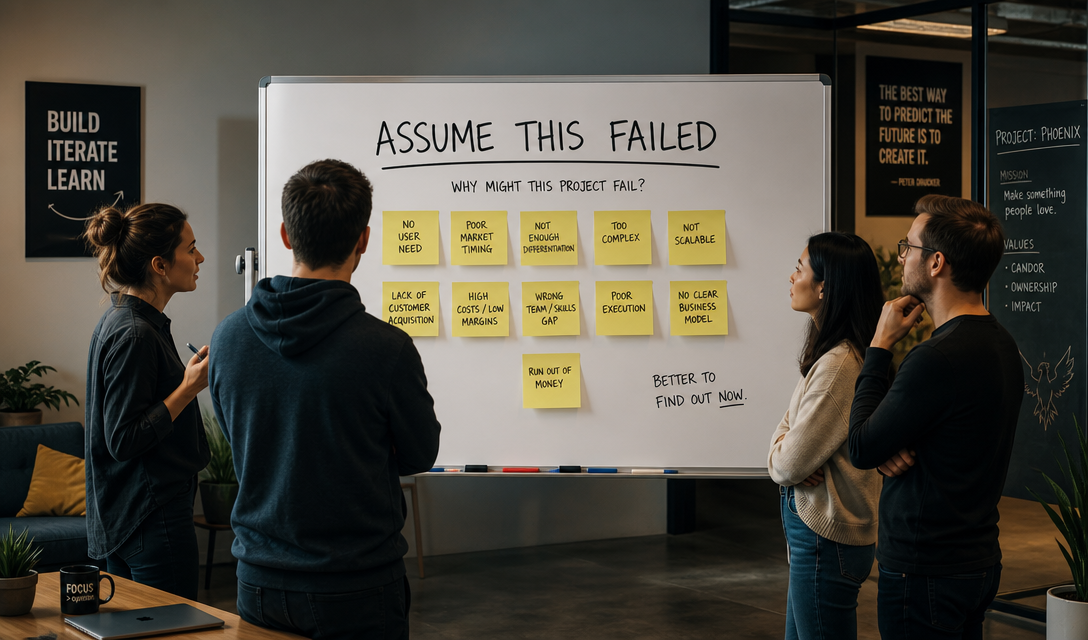
He called it a premortem. The technique was simple: gather your team, declare the project has already failed spectacularly, and ask everyone to independently write down why. No debate. No defensiveness. Just the cold clarity of hindsight applied before the fact.
It worked. Research by Mitchell, Russo, and Pennington confirmed why: people generate significantly more explanatory reasons when told an outcome has already happened than when asked to predict future risks. The term they coined — "prospective hindsight" — describes a cognitive cheat code. Your brain is better at explaining the past than predicting the future, so you trick it: treat the future as if it's already the past.
The technique has spent nearly two decades in the project management toolkit. But it's now crossing into startup strategy, and the reason is uncomfortably relevant to anyone building a product right now.
What the Best Teams Do Before They Start
David Bethoney, former president of The Muse, has seen hundreds of projects launch and fail. His observation: "The most successful projects often had one thing in common. The team conducted excellent premortems before the work began."
Bethoney's process surfaces three failure patterns that show up almost universally:
- Unrealistic timelines — not just optimistic, but structurally impossible given the resources assigned
- Treating other teams as afterthoughts — assuming marketing, legal, or compliance will "figure it out later"
- Stakeholders with conflicting definitions of success — one person thinks "launch" means "shipped to production," another thinks it means "first paying customer"
The formal premortem process has five steps: declare the project has already failed, have each person silently write failure reasons to prevent anchoring, capture one risk at a time with zero debate, prioritize the top 5-8 by likelihood and damage, and assign individual ownership for each risk.
What's striking is how none of this requires data you don't already have. It doesn't ask you to research competitors or run surveys. It asks you to access the knowledge already distributed across your team — knowledge that, in a normal planning meeting, gets buried under optimism and groupthink.
Founders Do the Opposite
Here's the uncomfortable part. The typical founder's validation process is the inverse of a premortem.
A premortem asks: "Assume this failed. Why?"
A founder asks: "Assume this succeeds. Who agrees with me?"
They build a landing page and show it to friends. Friends say "cool idea." They interpret politeness as market signal. They collect encouragement instead of evidence. Every "sounds interesting" becomes a data point for the "build" column. Every silence gets ignored.
This isn't a character flaw. It's how human cognition works under uncertainty — we seek confirming evidence and discount disconfirming evidence. The premortem is a structured intervention against that instinct.
The Validation Premortem: 5 Minutes, 5 Questions
You don't need a team or a formal workshop to run a startup premortem. You need five minutes and the willingness to be honest about your own idea. Here's the adapted process:
Step 1: Declare failure. Write this sentence at the top of a blank page: "It's 18 months from now. [Your startup name] failed. Nobody uses it. Here's why."
Step 2: Silent writing. Spend three minutes writing every reason you can think of — no filtering, no arguing with yourself. The research is clear: you'll generate more and better reasons if you treat the failure as already real.
Step 3: Classify each reason. For each failure cause, ask: is this a market risk (nobody wanted it), an execution risk (we couldn't build it well enough), a distribution risk (nobody found out about it), or a platform/ dependency risk (someone else's decision killed us)?
Step 4: Identify the fatal one. Of everything you wrote, which single assumption, if wrong, makes everything else irrelevant? This is your riskiest assumption — the one that deserves to be tested before you write a single line of code.
Step 5: Design the smallest test. What's the cheapest, fastest way to prove or disprove that assumption? Not a survey. Not a landing page with fake signups. A real test where someone — a stranger, not a friend — has to give up something real: time, attention, or money.
The Premortem-as-Software
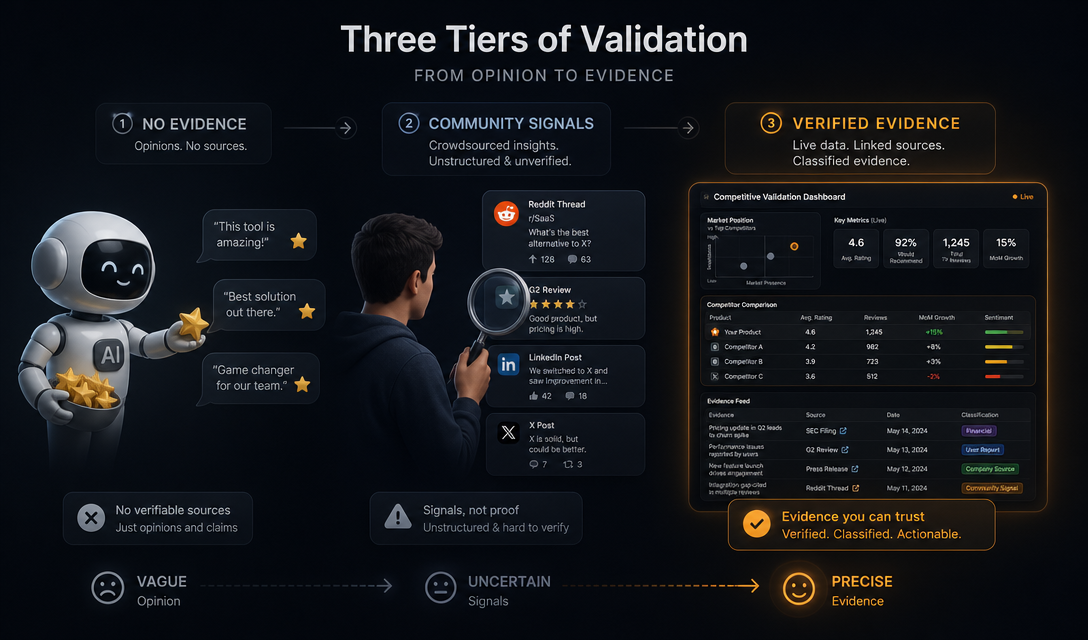
This is where the technique meets the tool. A proper validation premortem asks the same questions that a good idea validation report should answer automatically:
- Who else is already solving this problem, and how well?
- What's the single riskiest assumption in this idea?
- Is there evidence of real demand, or just evidence of politeness?
- If this fails, what's the most likely reason?
The premortem framework doesn't replace validation research — it gives you the right questions to ask before you start researching. It turns validation from "is this a good idea?" into "what would have to be true for this to fail, and is any of that already true right now?"
The Shift That Matters
Most founders approach validation like a permission slip. They want someone — a tool, a mentor, an audience — to tell them "yes, build this."
The premortem inverts that. It doesn't ask for permission. It asks for the truth you already suspect but haven't admitted.
The founders who run this exercise honestly often discover they already know why their idea would fail. They've just been too busy building to listen to themselves.
Before you write code, run the premortem. Assume it failed. Work backward.
You might find the fatal assumption before you build around it.